The popular story about Rigetti Computing is that Wall Street has turned on the quantum computing trade. It has not. Pull the analyst sheet and something stranger shows up: across the 13 analysts covering RGTI, the lowest twelve-month price target on the tape is $17.30, and the stock closed at $15.95 on 28 September 2026. Not one published target sits below the market price. The sell side does not have a bear case for Rigetti — it has a spread of bull cases of differing enthusiasm. That matters more than any single number, because it means the $5.32bn market capitalisation is being defended by a research community that has no modelled downside, on a company that booked $13.35m of revenue over the trailing twelve months. That is roughly 398 times sales. The stock is down 71.7% from its 52-week high and the consensus target still implies 79% upside.
Here is the part no one writes down. If you strip out the balance sheet, the valuation stops looking like a technology multiple and starts looking like a clinical-stage biotech. Rigetti finished Q2 FY2026 with $541.3m in cash, cash equivalents and available-for-sale investments. Against a $5.32bn market cap, that cash is about 10% of the price. The other 90% — call it $4.8bn — is a pure option on a physics result that has not happened yet. Biotech investors have a vocabulary for this. They do not value a phase-two oncology company on a revenue multiple; they value it on the probability-weighted outcome of one trial, and they know the readout date. Quantum hardware is being traded the same way, except most equity investors are still reaching for price-to-sales, a ratio that tells you nothing useful at 398 times. The readout for Rigetti is not a trial. It is a number called coherence time, and management has told you exactly where it sits.
Key facts
- RGTI closed at $15.95 on 28 September 2026, down 46.2% over twelve months and 71.7% below its 52-week high of $56.34 — Nasdaq daily closes, retrieved 29 September 2026
- Market capitalisation $5.32bn on trailing-twelve-month revenue of $13.35m, a price-to-sales multiple of roughly 398x — StockAnalysis, 29 September 2026
- Q2 FY2026 revenue $5.1m, operating loss $28.1m, cash and investments $541.3m — Rigetti Q2 2026 results, 6 August 2026
- Consensus target $28.53 across 13 analysts; street high $40, street low $17.30 — every published target is above the spot price — StockAnalysis, 29 September 2026
- Cepheus-1-108Q runs 108 qubits as twelve linked 9-qubit chiplets at 99.1% median two-qubit gate fidelity, against a stated 99.5% target for later in 2026 — The Quantum Insider, April 2026
- Coherence time, the binding constraint, sits at 25 to 30 microseconds — Rigetti Q2 FY2026 earnings call
- Rigetti signed a $100m definitive agreement with the US Department of Commerce — StockAnalysis company summary, September 2026
What is actually happening, and why the chart looks like this
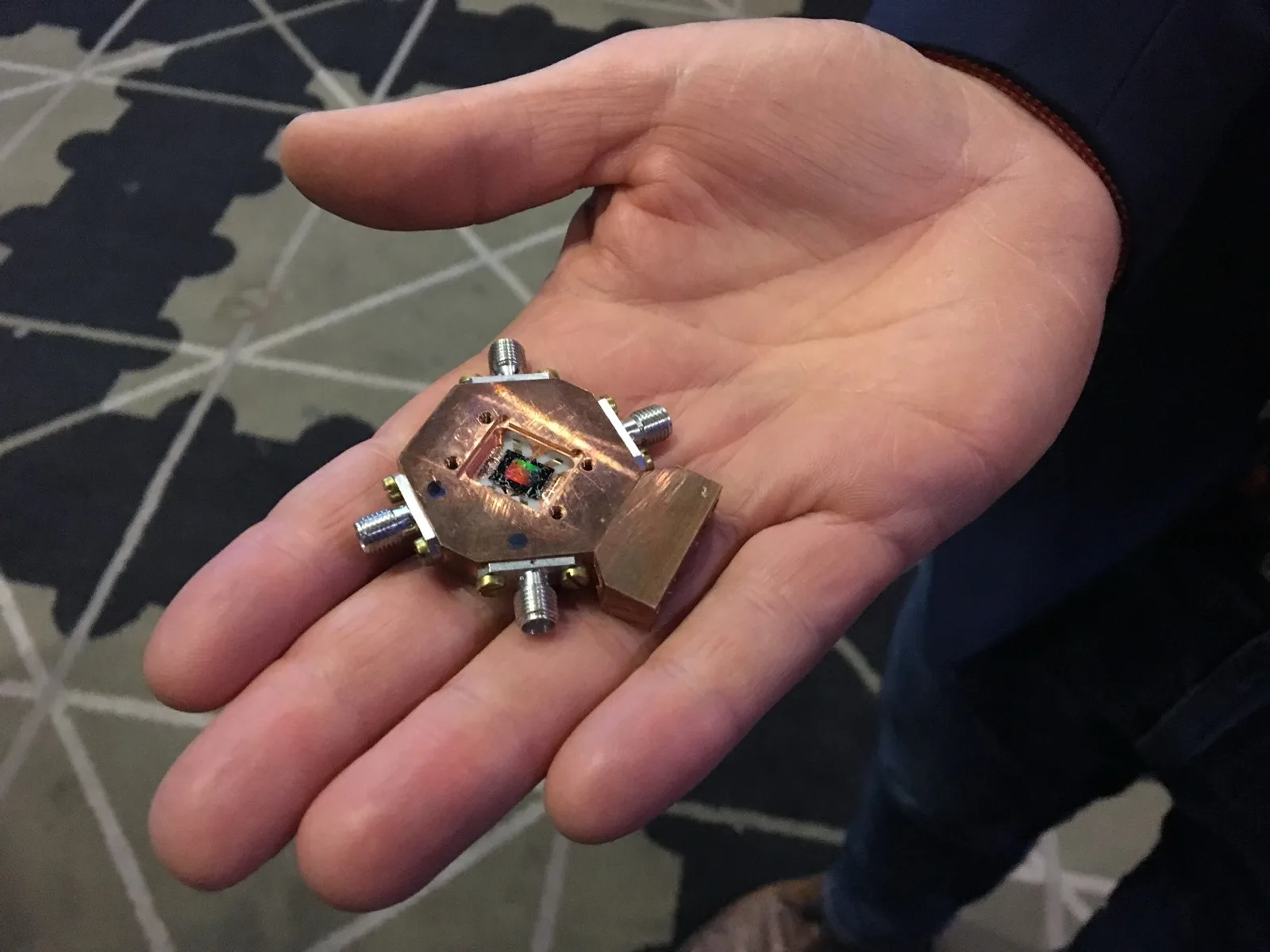
Rigetti builds superconducting quantum processors — tiny circuits of aluminium and niobium printed on silicon, chilled to a few thousandths of a degree above absolute zero, where they behave as artificial atoms. The commercial product is access: customers rent time on the machines through Rigetti’s own cloud, and through Amazon Braket, Microsoft Azure Quantum and qBraid. Some buy a system outright. That is a real business, and it is growing — but it is growing from a base so small that a single on-premises sale moves the quarterly line.
The technical story in 2026 has been Cepheus-1-108Q. Rather than fabricate one large chip and accept the yield penalty, Rigetti tiles twelve 9-qubit chiplets and links them, which is why the company describes it as the industry’s largest modular quantum system. Modularity is the right call — it is the same argument that pushed classical semiconductors toward chiplets, and we have covered that shift in the context of Intel’s own packaging roadmap. But modularity solves manufacturing, not physics.
The physics problem is coherence. A qubit holds its quantum state for a finite window before the environment scrambles it, and every gate operation has to fit inside that window. Rigetti’s gates are genuinely fast — roughly 60 nanoseconds for a two-qubit operation, which is among the quickest in superconducting hardware — and single-qubit fidelity is already at 99.9%. Two-qubit fidelity is the one that matters for real algorithms, and it is stuck at 99.1% because coherence times sit at 25 to 30 microseconds. Management was unusually direct about this on the Q2 call, naming coherence as the limiting factor and pointing to a specific fix: capping the niobium with tantalum, a materials change the team believes can deliver a two-to-threefold improvement.
That is the whole investment case compressed into one materials-science bet. “We remain focused on delivering against the milestones we have laid out, including fidelity improvements on Cepheus-1-108Q, higher qubit systems and disciplined execution of our capital plan,” chief executive Subodh Kulkarni told investors alongside the Q2 results. Read that literally: the company is telling you the milestone list is the thesis.
What the analysts and the counterparties are actually doing
The absence of a published bear case is not laziness. It is a structural feature of how small-cap deep-tech coverage works, and it has a cost for anyone using consensus as a guide.
Look at who covers the name. Benchmark’s David Williams has argued the quantum sector is accelerating and that Rigetti’s long-term strategy is supported by its execution. B. Riley Securities’ Craig Ellis raised his target from $19 to $35 while keeping a Buy. Needham has sat at $18 on a Buy. Cantor Fitzgerald initiated at Overweight. These are genuinely different views — a $17-to-$40 band is a factor of 2.4 — but they are all expressions of the same underlying stance, which is that the technology arrives. No one on the sheet is publishing the scenario where it arrives late enough that the cash runs down first.
Meanwhile the counterparties are voting with contracts rather than opinions, and their behaviour is more informative. Amazon, Microsoft and qBraid have all kept Rigetti hardware on their quantum cloud menus — which is a low-cost commitment, since none of them is taking inventory risk. The US Department of Commerce signed a $100m definitive agreement, and the UK has provided support as well. That is the tell worth watching: governments are funding the research, hyperscalers are reselling the access, and neither group is buying the company. Compare that with how compute demand gets financed elsewhere in AI, where counterparties take real balance-sheet exposure — Anthropic committed $11.6bn to Akamai and took a warrant struck at $111.33. Nobody is writing that kind of paper on quantum hardware yet.
The peer set tells the same story. IonQ has pushed its first Superion-256 revenue recognition out to late 2027, which is the sector’s honest admission that commercial quantum is a 2027-and-beyond revenue event, not a 2026 one. Rigetti’s own $13.35m of trailing revenue says the same thing in a different notation.
The market impact: what 398 times sales is actually pricing
Run the arithmetic in both directions, because it is more revealing than the multiple itself.
At $15.95 and 333.77m shares outstanding, Rigetti is a $5.32bn company. Net of $541.3m in cash and investments, the operating business is being valued at roughly $4.8bn. Trailing revenue is $13.35m and the trailing net loss is $238.67m. For the enterprise value to compress to a merely expensive 50 times sales — the kind of multiple a fast-growing infrastructure software company might carry — revenue would need to reach about $96m. That is a 7.2x increase from here.
Now the other direction. Q2 burned $28.1m at the operating line. Against $541.3m of cash, that is roughly nineteen quarters of runway at the current rate — call it four and a half years, before any capital raise and before the burn rate rises as headcount and fabrication scale. Rigetti is not, on this evidence, a solvency story in the near term. It is a duration story: the company can afford to wait, and the question is whether shareholders can afford to wait at this price.
| The case for $40 | The case for $9 |
| Tantalum capping lifts coherence 2–3x and two-qubit fidelity clears 99.5% on schedule | Coherence improvement lands late or partially; the 99.5% target slips into 2027 |
| $541.3m cash funds the roadmap without dilution through 2029 | Burn rises with fabrication scale and a raise arrives at a depressed price |
| Government contracts convert into recurring, budgeted programme revenue | Government money stays project-shaped and never compounds into a run-rate |
| Modular chiplets prove out and qubit count scales without a fidelity penalty | Chiplet interconnects add error faster than the materials fix removes it |
| Quantum sentiment re-rates the whole sector as it did in late 2025 | Sentiment normalises toward the peer group and the multiple compresses |
The bear column produces $9 in a specific way, and it is worth being explicit rather than hand-waving. At $9, Rigetti is a $3.0bn company — still about 225 times trailing sales, still 5.5 times its own cash pile, and still comfortably the second-largest listed pure-play in superconducting quantum. In other words, $9 is not a distress price. It is what the stock looks like if the technology stays on track but the market stops paying a scarcity premium for it, which is roughly what happened to the name between October 2025 and March 2026 when it fell from $56.34 to $12.90. The bear case here is a sentiment case, not a bankruptcy case. Anyone modelling actual failure would need a number well below $9, and that scenario is not what the $12.90 low tested.
Policy is the swing factor, and it cuts both ways
Quantum computing sits in an unusual policy position: it is simultaneously a subsidised national-security priority and a future regulatory target, and Rigetti is exposed to both.
On the subsidy side, the $100m Department of Commerce agreement is the most concrete validation Rigetti has. Washington has decided that domestic quantum fabrication is strategic, in much the same way it decided domestic leading-edge logic was strategic. That is a genuine tailwind, and it is the reason the cash position looks as comfortable as it does. The UK has provided support too, which diversifies the political risk.
The tension is that government money is not commercial revenue, and investors frequently conflate the two. A programme contract is milestone-shaped: it funds specific deliverables over a defined period, it does not renew automatically, and it produces lumpy recognition rather than a compounding run rate. When Rigetti reports a strong quarter driven by a Novera QPU sale to a government lab, that is a real sale — but it is not the same signal as a commercial customer expanding cloud consumption for the fourth quarter running. The market has not consistently distinguished between the two, and the day it starts to is the day the multiple gets tested.
The second policy vector is export control. Quantum processors with credible cryptanalytic potential are exactly the class of technology that attracts controls, and the direction of travel in Washington has been toward more restriction, not less. For Rigetti that is double-edged: controls entrench domestic players against Chinese competition, but they also fence off addressable market and add compliance cost to a company with 333.77m shares and $13.35m of revenue. A third vector, further out, is the “harvest now, decrypt later” problem driving post-quantum cryptography migration deadlines across financial infrastructure. That is a demand tailwind for the sector, but it accrues to whoever has a working machine when the deadlines bite — which returns the argument, again, to coherence time.
What happens next
Three things are worth watching, in order of how much they move the price.
First, the fidelity print. Rigetti has committed to roughly 99.5% median two-qubit gate fidelity on Cepheus-1-108Q “later in 2026”. That is a falsifiable, dated claim on a specific number, which makes it the closest thing this sector has to a biotech readout. If it lands, the bull case is substantially de-risked and the street-high $40 becomes defensible on momentum alone. If it slips to 2027, expect the stock to retest the low teens regardless of how the revenue line looks, because the entire multiple rests on schedule credibility.
Second, the revenue mix. Watch whether commercial cloud consumption grows independently of hardware sales. Trailing revenue of $13.35m against a $5.32bn valuation means the market is not paying for the current mix at all — but a quarter that shows recurring cloud usage compounding, rather than a one-off Novera sale, would be the first evidence that a revenue multiple is even the right tool.
Third, and most likely to be mispriced: the raise. With nineteen quarters of runway at the current burn, Rigetti does not need capital. Companies in this position nonetheless tend to raise opportunistically into strength, and a raise announced immediately after a good fidelity print would be both rational and dilutive. Treat any sharp post-milestone rally as an elevated window for an equity offering rather than a clean re-rating.
Our working view: $40 requires the fidelity milestone to land on schedule and sector sentiment to cooperate, which is two conditions, not one. $9 requires only the second to fail. That asymmetry — not the consensus $28.53 — is the honest summary of where this stock sits, and it is precisely the asymmetry a sell-side sheet with no bear case cannot express.
Frequently asked questions
What is the Rigetti stock prediction for 2026?
Our bull case is $40, matching the street-high target, and our bear case is $9. The consensus of 13 analysts sits at $28.53 with a range of $17.30 to $40. The critical variable is whether Rigetti hits its stated ~99.5% median two-qubit gate fidelity target on Cepheus-1-108Q before the end of 2026.
Why is the RGTI bear case below every analyst target?
Because no covering analyst currently publishes a target beneath the market price. The lowest is $17.30 against a $15.95 close. Our $9 reflects a scenario the sell side does not model: the technology stays on track but the scarcity premium compresses, roughly repeating the October 2025 to March 2026 de-rating from $56.34 to $12.90.
How much cash does Rigetti have, and how long does it last?
$541.3m in cash, cash equivalents and available-for-sale investments as of Q2 FY2026, against a $28.1m quarterly operating loss. That is roughly nineteen quarters of runway at the current burn rate, before any capital raise and assuming the burn does not accelerate.
Is Rigetti profitable?
No. Trailing-twelve-month revenue is $13.35m against a net loss of $238.67m. The company is valued at roughly 398 times sales, which means the market is pricing a technical outcome rather than a financial one.
What is coherence time and why does it matter for RGTI stock?
Coherence time is how long a qubit holds its quantum state before environmental noise destroys it. Rigetti’s sits at 25 to 30 microseconds, and management has identified it as the factor capping two-qubit gate fidelity at 99.1%. Because the valuation is an option on reaching useful fidelity, coherence time is functionally the company’s most important operating metric.
How does Rigetti compare with IonQ?
They use different physics — Rigetti builds superconducting circuits, IonQ uses trapped ions — but they face the same commercial timeline. IonQ has guided first Superion-256 revenue to late 2027, which brackets the sector’s realistic revenue inflection well beyond 2026.
This article is for information only and is not investment advice. Price targets are scenario analysis, not forecasts. Quantum computing equities are exceptionally volatile and carry a risk of total loss.