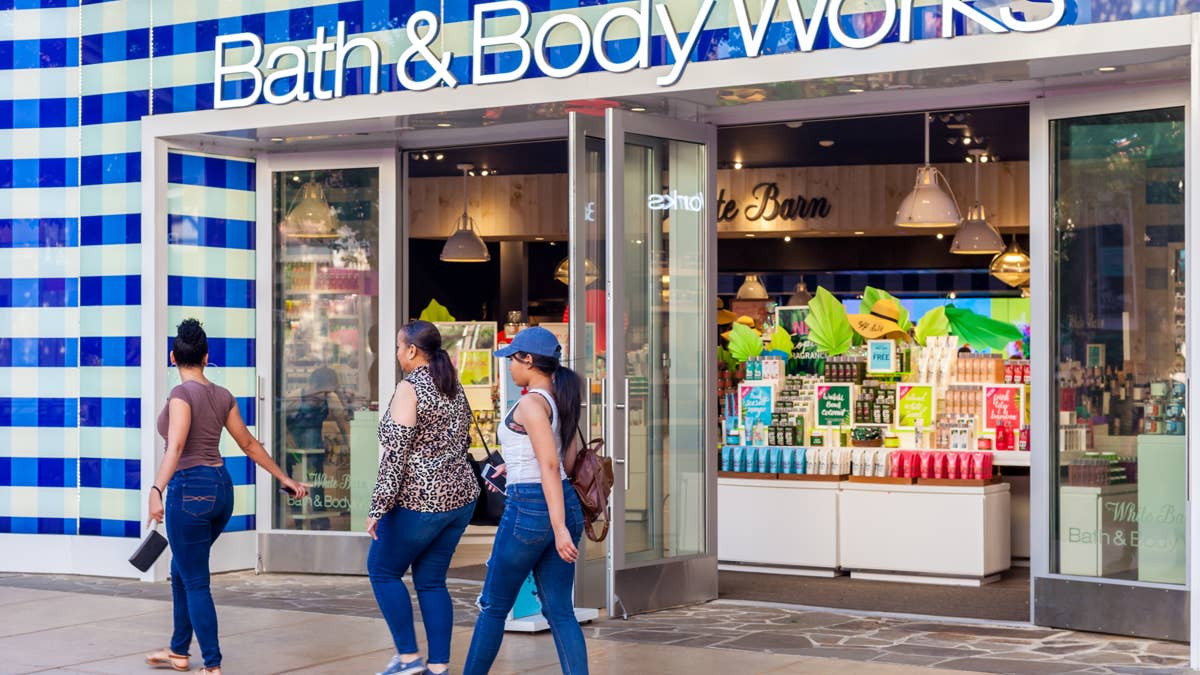
A familiar name in retail is quietly reshaping its footprint, closing stores, slowing expansion, and rethinking how it connects with customers in a rapidly changing shopping environment.
This isn’t a reaction to a single weak quarter. Rather, it reflects a major shift across the retail industry, where convenience, speed, and digital access are increasingly shaping how and where consumers spend.
Mall traffic has softened over the past few years, while online shopping has accelerated. Now, that broader transformation is showing up in one company’s strategy.
Bath & Body Works closes dozens of locations
Bath & Body Works (BBWI) has closed 92 stores worldwide since February 2025, including 62 in the U.S. and 30 internationally, according to the company’s fourth-quarter 2025 earnings report.
In the fourth quarter alone, the company shuttered 28 North America locations and seven international stores, according to its latest earnings call.
These closures are part of a broader effort to reposition its physical footprint by shifting away from traditional malls.
Today, around 60% of Bath & Body Works’ stores are located outside malls, and all new North American locations opened during the quarter followed that off-mall strategy. Meanwhile, most closures were concentrated in mall-based sites.
While the company has not halted expansion entirely, it expects to further reduce store openings in the coming year, signaling a more cautious, efficiency-driven growth approach.
Shutterstock
Bath & Body Works’ performance pressures add urgency
Recent Bath & Body Works financial results help explain the strategic pivot.
In the fourth quarter of fiscal 2025:
- Net sales declined 2% year over year.
- Net income fell 11%.
- North America store sales dropped 2.6%.
- North America direct digital sales decreased 2.5%.
Looking ahead, the company expects net sales to decline between 2.5% and 4.5% in fiscal 2026.
A new strategy takes shape
To address the challenges, Bath & Body Works introduced its “Consumer First Formula” in late 2025, focused on four priorities:
- Product innovation: Emphasizing ingredient-led, trend-driven products in core categories while simplifying assortments
- Brand relevance: Investing in cultural impact, marketing, and signature fragrance franchises
- Customer reach: Expanding across digital, physical, and wholesale channels
- Increase speed and efficiency: Reducing complexity and reinvesting savings into growth
Alongside, the company also launched a multi-year cost-saving initiative called “Fuel for Growth,” targeting $250 million in savings over two years. About $175 million of that is already factored into its 2026 outlook.
Bath & Body Works emphasized simplifying operations, accelerating decision-making, and improving overall productivity as central to the turnaround effort.
Bath & Body Works expands its digital presence
Known for its strong in-store experience, including its upgraded “Gingham+” concept introduced in 2025, Bath & Body Works is now leaning more heavily into digital and third-party distribution.
“Our goal here is simple: be in the path of the consumer, spark discovery, and ensure the Bath & Body Works brand shows up consistently and powerfully across every owned and partner touchpoint,” said Bath & Body Works CEO Daniel Heaf in a recent earnings call.
This includes a notable move in February 2026, when the company launched a curated product assortment on Amazon U.S., expanding its reach beyond its own channels and into a platform where millions of consumers already shop.
That move aligns with broader industry trends. U.S. E-commerce spending reached approximately $1.34 trillion in 2024 and is projected to surpass $2.5 trillion in 2030, according to Capital One Shopping.
U.S. online sales accounted for 22.3% of global e-commerce spending in 2024, up nearly 1.5% from the year prior.
Why physical stores still matter
Despite the digital push, physical retail remains dominant. Brick-and-mortar stores accounted for approximately $14.4 trillion of the $18.9 trillion in total retail sales in 2025, significantly outpacing e-commerce, according to Euromonitor research gathered by EY.
“It’s clear that the physical store still plays an important role,” said EY Retail Analysts Malin Andrée and Jon Copestake. “Not only do stores have plenty of runway left in delivering revenue, but they also have opportunities to drive new growth and alternative revenue streams and, by working in tandem with digital channels, they can maximize returns on investment.”
This contrast shows that stores remain essential but must evolve to justify their existence.
Coverage on more retail store closures:
- A major retailer scales back after expansion misstep
- Fashion brand shuts down website, all stores may close
- 115-year-old fashion brand exits entire market in 2026
- 72-year-old mall retailer to close more stores in 2026
Sharmila C. Chatterjee, a marketing lecturer at MIT Sloan School of Management, has emphasized that retailers must combine operational efficiency with customer-centric innovation, including optimizing merchandise assortment, leveraging artificial intelligence and data analytics, reducing wait times, improving return policies, and investing in store design.
“The future of retail is a hybrid of online and offline channels,” said Chatterjee in a study. “To keep customers coming back, retailers need to make strategic investments, experiment with new approaches, and, inevitably, engage in some trial and error as they figure it out.”
What the shift means for the future of retail
The changes underway at Bath & Body Works reflect a broader industry-wide transformation.
Retailers are not simply choosing between physical and digital; they are being forced to optimize both simultaneously. Companies that once relied heavily on mall traffic are now reallocating resources toward off-mall locations, e-commerce, and third-party platforms.
What makes Bath & Body Works notable is that its sales are declining across both stores and digital channels, underscoring that the challenge is not just where consumers shop, but how much they are spending and what they expect in return.
That raises the stakes for execution.
Retailers that integrate physical stores into a broader omnichannel strategy while maintaining product relevance and brand differentiation are more likely to stabilize performance and return to growth. Those that fail to adapt may continue to shrink their footprints as consumer behavior shifts further toward convenience-driven shopping.
Related: Dunkin’ could exit an entire market in 2026 after 14 years
