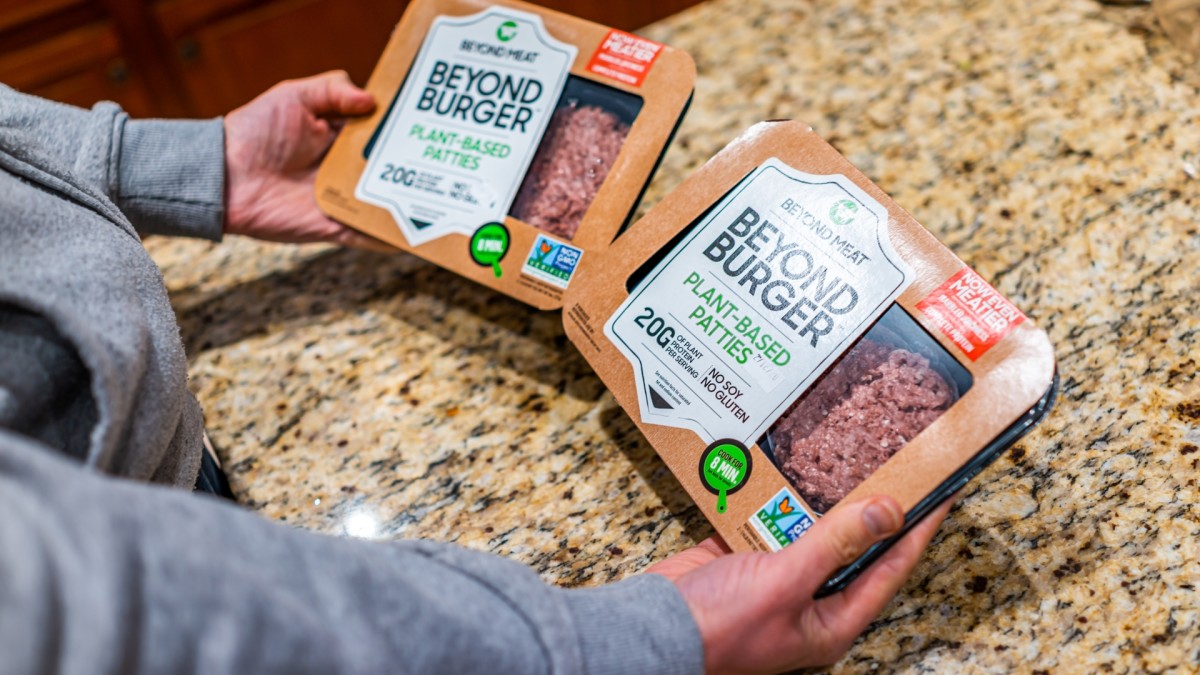
Plant-based protein products have become less popular with customers in recent years. But that hasn’t stopped Beyond Meat from trying to win over shoppers with new products.
Beyond Meat recently rebranded as Beyond and has released two protein drinks to try and capture the growing protein shake market, TheStreet reported.
Now the company has made a bold claim about its products and climate change.
Beyond Meat still struggling financially
Beyond Meat has faced financial distress for several years. Its most recent quarterly filings show a company struggling to gain a footing with cash-strapped Americans.
In an earnings call with investors, Beyond Meat’s CEO Ethan Brown blamed the company’s struggles on a change in how Americans perceive meat alternatives.
“This is a very difficult period for the world, and it’s a difficult period for our country…. Nothing in our lane is a more obvious representation of this troubling trend than the resurgence of red meat,” he said.
His words were a subtle stab at a recent government change in the food pyramid, which prioritizes red meat, despite health warnings from experts.
Now the company says its products aren’t just good for you, but good for the planet as well.
Shutterstock
Beyond Meat says buying its products can help save the planet
In early April, two of Beyond Meat’s products qualified as climate solutions, the company shared.
The qualification is based on criteria outlined in the Climate Solutions Framework developed by the Exponential Roadmap Initiative (ERI).
According to the ERI, a climate solution is a product that contributes to global emission reductions by producing at least 50% less emissions than other options on the market.
In the case of food, emissions vary largely by product. The agriculture industry in the U.S. accounted for 257.35 metric tons of greenhouse gases in 2024, compared to 4,333.6 metric tons globally, according to the World Bank.
Climate emissions of food products
- Beef has the largest footprint, creating nearly 100 kilograms of greenhouse gas emissions for every kilogram of product, Statista indicated. One kilogram is equal to roughly 2.2 pounds.
- Dark chocolate is the second-largest emitter, with 47 kilograms of CO2 emissions.
- Lamb and mutton produce about 40 kilograms of emissions, while dairy cows create 33 kilograms for every kilogram of product.
- Even your morning cup of joe creates emissions, at roughly 28.5 kilograms of greenhouse gases for every 2.2 pounds of coffee.
- In comparision, meat alternatives such as tofu and pea protein have a smaller footprint. Tofu creates only 3.16 kilograms of emissions, while peas emit 0.98 kilograms of greenhouse gas for every kilogram of product.
For Beyond Meat, its plant-based burger and steak products are said to produce less C02 emissions than beef because they source protein from peas and other products that release less greenhouse gas compared to beef products.
“We are thrilled to recognize pioneering products such as Beyond Burger and Beyond Steak that support the global transition toward a net zero economy,” said Johan Falk, CEO of the Exponential Roadmap Initiative.
Beyond Meat says a two-pack of its burgers require 97% less land use, use 92% less water, and generate 88% less greenhouse gas emissions.
“We believe in the power of plants to fuel our bodies and to heal the planet,” said Brown.
Americans are not embracing plant-based meat alternatives
While Beyond Meat might be good for the environment, it remains to be seen whether it sticks around long enough to make a huge difference. The company has struggled financially for a while.
Plant-based diets are not as popular in America as they once were. While many Americans eat plant-based meat occasionally, it doesn’t make up the bulk of people’s diets, according to a consumer report on plant-based meat by GFI.
More retail news
- More trouble brewing for Albertsons and Kroger
- Low-priced Walmart rival steps up expansion plans
- Visa says AI will change how you shop
Many Americans who eat plant-based meat also eat beef and other types of meat, the report found.
According to that report, 53% of Americans have reported eating plant-based meat at some point. But only 11% eat it weekly, while 13% have eaten a plant-based meat product, but not in the past year.
A big reason why people don’t eat plant-based alternatives like Beyond Meat? They simply prefer animal meat or don’t like the taste of the plant-based version. And for some, it’s just too expensive.
Related: Costco explains a controversial sales decision
