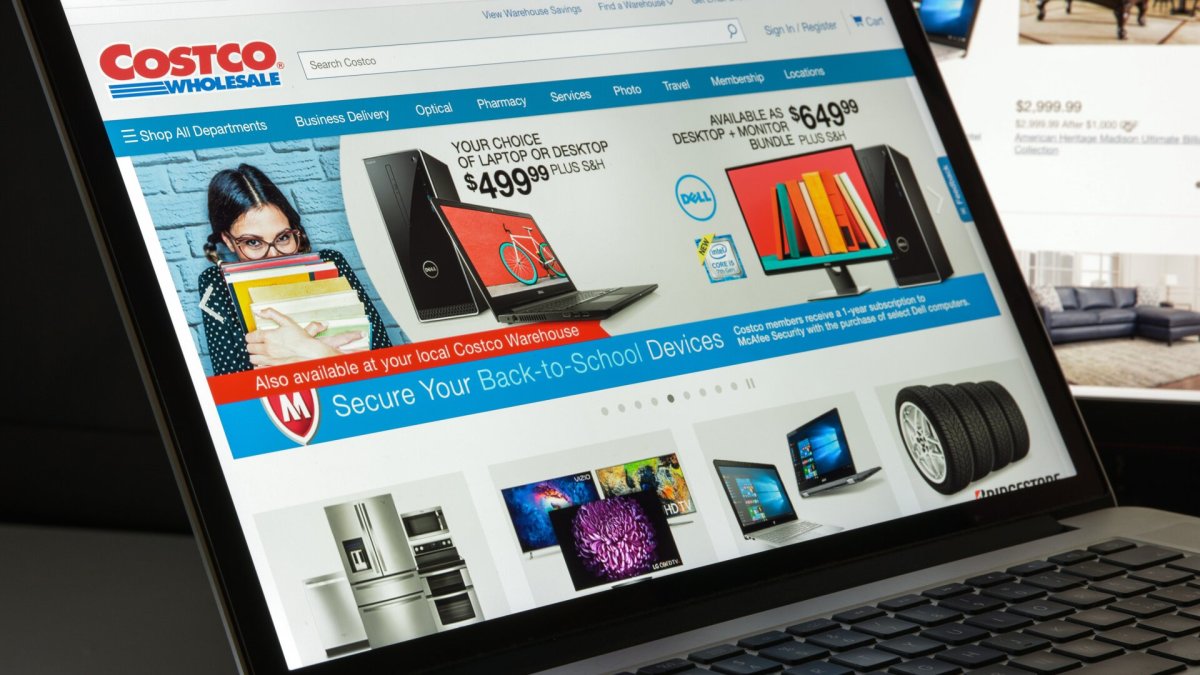
For decades, Costco offered members a simple proposition. Pay an annual membership fee and get access to the chain’s warehouses, where it sells a narrow selection of high-volume items at very good prices.
Until 1998, Costco did not even sell items directly through its website. You had to visit its stores if you wanted to buy anything.
Even when it did add some online sales, they were limited for many years, and not a focus of the brand. Now, Costco has quietly come into the modern age with CEO Ron Vachris laying out the chain’s digital investments during its first-quarter 2026 earnings call.
Costco online sales: a brief timeline
- The site originally started as an informational web presence in the mid-1990s, but e-commerce (actual online selling) began in November 1998.
- Costco later expanded its online offerings; for example, it launched a business-oriented e-commerce site in April 2001 that allowed companies and members in select areas to shop for business products online.
Source: Costco Investor Relations - 2017 onward: Costco introduced and expanded online grocery and delivery options, including CostcoGrocery and later partnerships with Instacart, adding thousands of everyday items that better reflect a larger portion of what members could buy in warehouses, according to Supermarket News.
- 2020s: During and after the Covid pandemic, Costco’s online sales expanded dramatically and increasingly mirrored a fuller array of warehouse inventory, though the in-warehouse experience and “treasure hunt” merchandise strategy still means not every SKU is always listed online, reported AOL.
When the grocery selection and Instacart option launched in 2021, former Costco CFO Richard Galanti offered a sort of muted endorsement.
“We feel good that we’ve got a few delivery options for our members that, frankly, are better than the ones they were doing the day before,” he said during the retailer’s fourth quarter 2017 earnings call.
“So we feel that to the extent that somebody wants to choose to use that route, they’ll be able to and we’ll be able to generate the sales from it.”
Shutterstock
Costco invests in digital
Costco has traditionally let rivals like Walmart, Target, and Amazon innovate, while it sat back and watched what consumers wanted. That’s a cheaper approach that allows the company to spend less money developing technology and fail less often on implementation because they already know what members want.
“Turning to digital. Our digital vision at Costco is to deliver a seamless experience that builds trust and loyalty with our members, both in warehouse and online. We aim to make shopping at Costco easier, faster, and more personal, no matter where or how our members choose to shop,” CEO Ron Vachris said during the Q1 earnings call.
He made it clear, however, that Costco has not changed its mission.
“This isn’t about technology for technology’s sake. It’s about using technology to strengthen the fundamentals that make Costco who we are. Increasing member loyalty, driving top-line sales, and improving efficiency in our operations so that we can bring goods to market at the lowest possible price,” he added.
Costco does not break out digital sales in its quarterly earnings reports. Digitally enabled comparable sales, however, rose by 20.5% in Q1, according to its earnings release.
Related: History of Costco: Company timeline and facts
Costco has already made some digital changes
Vachris laid out some technology-based changes Costco has already made.
- In-warehouse implementation of scanning memberships at entry.
- The Costco Digital Wallet (a feature in the Costco app where members can store a payment method).
- Pre-scanning small- to medium-sized baskets while customers are in line at checkout.
“This is leading to better member experience and improved productivity. The warehouses that are first to adopt this pre-scan technology have shown checkout speed improvements of up to 20%. And across our U.S. warehouses overall, we achieved record levels of checkout productivity in the final weeks of the quarter,” Vachris shared.
Costco is still acting like Costco
GlobalData Managing Director Neil Saunders does not think Costco has undergone a “radical reinvention.” He believes that Vachris’ management team, which took over on Jan. 1, 2025, sees an opportunity to use technology better.
“In my view, he is correct in his assessment. Costco can improve in areas like collect-from-store, checking what’s in stock at the warehouse, and making the e-commerce process easier,” he wrote on RetailWire.
The changes, he noted, will be selective.
“Costco isn’t going to offer every item for collection because some of its bulky products just don’t lend themselves to that kind of service, and most customers love visiting the warehouse. So, I’d say this is all more of a gentle technology evolution than a massive transformation,” he added.
His Brain Trust colleague, Nikki Baird, vice president of strategy at Aptos, thinks it’s a question of the chain’s model and leverage.
“When you could compete and win at the scale of a Costco or Walmart by focusing on treasure hunt, range, and price, then it made sense to keep tech to a minimum. But when you need tech to enable whole new business models — like marketplace, retail media networks, and home delivery — there’s no way to continue to win by just focusing on the in-store experience,” she wrote.
Dominick Miserandino, CEO of Retail Tech Media Nexus, told TheStreet that Costco has a very simple motive with its tech investments.
“Costco isn’t digitizing for buzz. Its digital and in-store tech is translating directly to faster service and stronger member engagement,” he shared.
Related: Costco adds limited-time food court treat to rival McDonald’s
