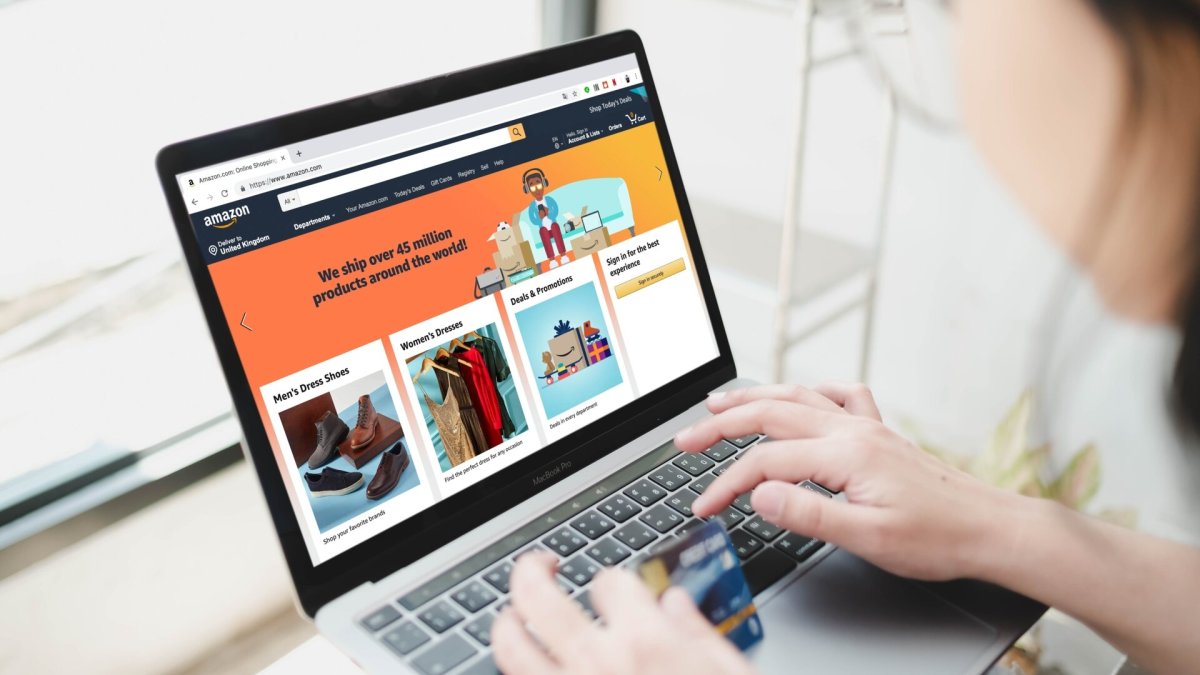
Amazon has long dominated the online space. But the company’s success didn’t happen overnight.
A big strength of Amazon is that the company is not afraid to dip its toes into different waters.
Just look at its origins compared to where the company is now. While Amazon started as a humble online book seller, nowadays, it’s hard to find a product the company doesn’t sell.
Not surprisingly, Amazon’s recent 2025 fourth-quarter results were impressive in many ways.
- Net sales increased 14% to $213.4 billion year over year.
- Operating income increased to $25 billion.
- Net income increased to $21.2 billion.
“We are seeing strong growth, and with the incremental opportunities available to us in areas like AI, chips, low-earth orbit satellites, quick commerce, and serving more consumers’ everyday essentials needs, we have a chance to build an even more meaningful business in Amazon.com, Inc. in the coming years,” Amazon CEO Andrew Jassy said.
Shutterstock
Amazon sees big opportunities in physical stores
Because of its speedy delivery and competitive price points, Amazon has the opportunity to do well in all corners of retail.
But given that many consumers are cutting back on discretionary spending due to lingering inflation and economic concerns, it makes sense for Amazon to hone in on a category that’s non-negotiable — groceries.
During the company’s Q4 2025 earnings call, Amazon shared plans to open more than 100 new Whole Foods Market stores over the next few years.
Related: Target’s big store push ignores frustrated shoppers
“With over $150 billion in gross sales, Amazon.com, Inc. is clearly a large grocer at this point,” Jassy said. “Customers in thousands of U.S. cities and towns can now get perishables delivered same day alongside millions of other items.”
But Amazon isn’t just expanding its Whole Foods line. As Reuters reported, the company is also opening a 225,000-square-foot mega-store outside Chicago.
It’s the online retail giant’s first store of this kind, and it will sell everything from fresh produce to household essentials. The store will also serve as a distribution center for same-day deliveries.
Amazon could encroach on Costco and Walmart’s turf
When we think of megastores, it’s natural to think of giants like Costco and Walmart that have long dominated in the physical store space. The big question now is whether Amazon will enjoy enough success with its Chicago-area superstore to take business away from some of its biggest competitors.
Amazon saw “significant adoption” of its same-day grocery services over the past year, Brian Olsavsky, the company’s CFO, shared during its most recent earnings report.
Related: Dollar Tree quietly adds more higher-priced items
But some retail experts are skeptical about whether Amazon will enjoy enough success in physical retail to be a true threat to established names such as Costco and Walmart.
“At this stage, the store is more experimental than anything else,” Neil Saunders, managing director of GlobalData’s retail division, told RetailWire. “Whether this works remains to be seen.”
Saunders also pointed out that Amazon’s track record of physical store concepts isn’t great.
“They tend to focus too much on technology and not enough on customers and differentiation,” he explained. “Given there are so many physical stores to choose from, those things are critical.”
“There’s no evidence Amazon has unique insight into stores,” said Protonik President Doug Garnett, according to RetailWire.
More Retail:
- Costco sees major shift in member behavior
- Retail chain shuts all locations as legal changes hit industry
- Costco makes major investment in online shopping for members
- Lululemon struggles to reverse concerning customer behavior
- T-Mobile launches free offer for customers after major loss
Others, however, think Amazon’s megastore could be successful with the right approach.
“If Amazon were to stuff 220,000 sq. feet with an eclectic assortment of quality returns at really great prices — that’s a treasure hunt that could generate some fun, margin, and take care of some of the problems of reverse logistics,” Peter Charness, UST’s retail strategy vice president, told RetailWire.
All told, Amazon’s approach to inventory could dictate whether its new megastore is the first of many, and whether it will give its competitors something real to worry about.
Maurie Backman owns shares of Amazon and Costco.
Related: Costco quietly changes its famous return policy
